

Die Erkältung
Die Erkältung is the term for a common cold, and to say ‘I have a cold’, you would say either ‘ich habe eine Erkältung’ or ‘ich bin erkältet’. Some of your symptoms may include Halsschmerzen or Halsweh (sore throat), eine laufende or verstopfte Nase (runny or blocked nose), Kopfschmerzen (headache) or Husten (cough).
Examples:
Ich bin erkältet und habe eine laufende Nase. Kannst du mir mal einen papiertaschentuch geben?
I’ve got a cold and my nose is runny. Please can you pass me a tissue?
Ich habe Kopfschmerzen, weil ich eine Erkältung habe.
I have a headache because I have a cold.
Die Grippe
When a more serious winter illness hits you, it’s often die Grippe, the flu. Symptoms involve Fieber (fever), Schüttelfrost (chills), Gliederschmerzen (muscle aches), Schmerzen (aches) and Appetitlosigkeit (loss of appetite). While both Erkältungen and Grippe are very ansteckend (contagious), the latter is more serious, and you’re more likely to require a doctor for it.
Examples:
Ich habe die Grippe und kann heute nicht arbeiten.
I’ve got the flu and can’t work today.
Meine Symptome sind hohes Fieber, Gliederschmerzen und Appetitlosigkeit.
My symptoms include a high fever, muscle aches and a loss of appetite.
Husten
Having a cough, or Husten, is a particularly galling winter experience. Not only is it frustrating and disruptive, but it can lead to Heiserkeit (hoarseness) and Keuchen (wheezing). It can also be the sign of a more serious illness, Atemwegsinfektion (chest infection) or Lungenentzündung. (pneumonia)Examples:
Ich kann nicht sprechen, weil ich schrecklichen Husten habe.
I can’t speak because I have a terrible cough
Ich habe seit einer Woche Husten und mache mir Sorgen, dass ich eine Atemwegsinfektion habe.
I’ve had a cough for a week and I’m worried that I’m suffering from a chest infection
Die Entzündung
Winter illnesses often include Entzündungen (inflammations), which are often schmerzhaft (painful) and cause Rötung (redness). Common inflammations include Nebenhöhlenentzündung (sinusitis), Bronchitis (bronchitis) and Mandelentzündung (tonsillitis), which, unfortunately, are not the easiest terms to remember when you’re not feeling well.
Examples:
Meine Schläfen tun mir weh. Ich denke, dass ich Nebenhöhlenentzündung habe.
My temples really hurt. I think I have sinusitis
Ich habe eine Mandelentzündung und kann nichts schlucken.
I’m suffering from tonsillitis and can’t swallow anything.
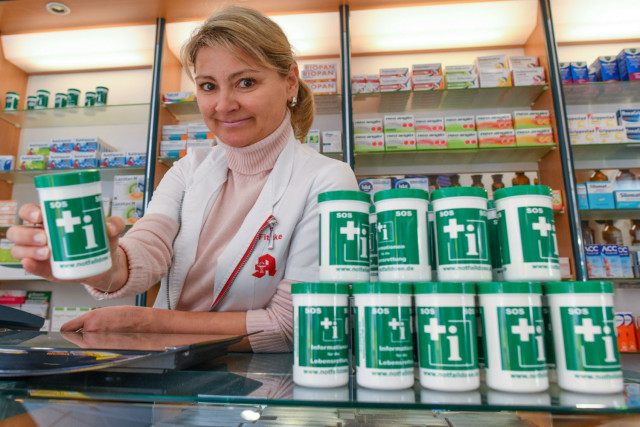
The Apotheke will always make you feel better. Photo: DPA
Die Apotheke
If you’re lucky enough to just have contracted a common cold, rather than the flu, you should be able to make it to the Apotheke (pharmacy). At the Apotheke, you can buy Medikamente (medicines), although these tend to be behind the counter in Germany, so it’s worth knowing how to describe your symptoms before you go. Examples of different types of medications include Tabletten (pills), Lutschtabletten (lozenges) and Hustensaft (cough syrup).
Examples:
Haben sie etwas, das den Schleim im Hals lösen kann?
Do you have something that can loosen the phlegm in my throat?
Ich suche Tabletten, die Kopfschmerz und eine Nebenhöhlenentzündung lindern.
I’m looking for tablets which soothe headaches and sinusitis.
Ich kann überhaupt keine Tablette schlucken. Haben Sie dafür auch flüssige Medizin?
I really can’t swallow pills. Do you perhaps have a liquid medicine for it?
Die (Arzt)Praxis
If, however, you’re unfortunate enough to be afflicted with a more serious Krankheit (illness), you might need to go to the doctor, or zum Arzt gehen. A doctor’s surgery is called eine Praxis, and it’s where you’ll have your Arzttermin (doctor’s appointment). You can visit a Hausarzt or Allgemeinarzt (general practitioner), although in Germany it’s relatively easy to visit a specialist, or a Facharzt. It’s worth noting that, in typically German style, most doctors close on Sundays.
Examples:
Ich gehe Freitag wegen meines Ekzems zur Dermatologin.
On Friday I’m going to the dermatologist for my eczema.
Ich habe die Praxis im Internet gefunden und sie angerufen, um einen Termin zu vereinbaren.
I found the practice on the internet and rang up to make an appointment.
Der Allgemeinarzt hat mich zum Osteopath weitergeleitet.
The GP referred me to the osteopath.
Im Notfall
In case of serious medical emergencies, you can also ring 112 (this is actually the number of the fire brigade, but this department also deals with medical emergencies). After you have given details of your circumstances, they may send a Krankenwagen (ambulance) to take you to the Krankenhaus (hospital), and probably to the Notaufnahme department (Accident and Emergency).
Examples:
Wir brauchen einen Krankenwagen, weil meine Tochter Blut erbricht.
We need an ambulance because my daughter is vomiting blood.
Wir waren im Krankenhaus, da mein Mannohnmächtig geworden ist.
We went to the hospital as my husband had fainted.
Comments (1)