
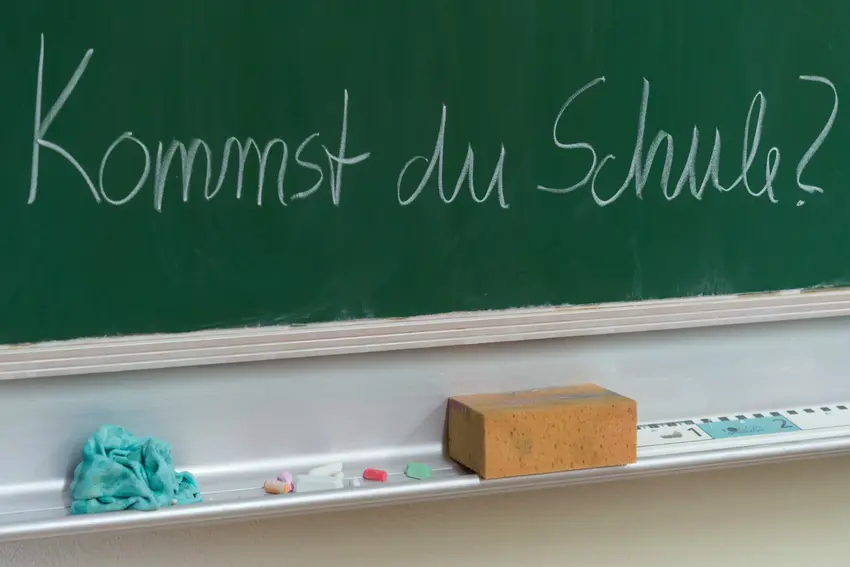
Kiez itself is a colloquial term for ‘neighbourhood’, so ‘hood German’ is perhaps an apt translation of the phrase.
Popular media has often depicted Kiezdeutsch as corrupting the German language, spoken by poorly integrated immigrants who have failed to learn German well. In films and television programmes, speakers of Kiezdeutsch are often portrayed as uneducated and badly behaved.
Consider, for example, the comedy duo of Erkan and Stefan; comparable with Britain’s Ali G, the pair were renowned for their derisive use of an artificial dialect which combined Turkish and Bavarian accents littered with English slang.
Yet linguists describe Kiezdeutsch as a Kontaktsprache (contact language): another variant of German, enriched by the many language backgrounds which inform its grammar and pronunciation.
Contact languages arise as people of differing ethnicities and mother tongues live within proximity of each other and intermingle. While Kiezdeutsch is most popular among young people of immigrant origin, who adopt Turkish or Arabic words into their spoken German, it is also employed by other young Germans, who learn this new terminology from their friends. Kiezdeutsch is most prevalent in areas of Berlin such as Kreuzberg and Wedding, where there are high rates of linguistic, ethnic and cultural diversity.
Helping to establish identity
Linguists, however, argue that Kiezdeutsch is a tool which helps to establish identity amongst its users. The issue was first brought to public attention in 1995 with the publication of Feridun Zaimoglu’s Kanak Sprak, a book which contained 24 transcripts of meetings with young German-Turkish men.
Kanak was a derogatory term for people of Turkish, Middle Eastern or North African origin. The book, however, dealt with the idea of reclaiming the term in a positive way, as a means of fostering identity.
Norbert Dittmar of the Free University of Berlin labels the ethnolect as a ‘linguistic Identikit’. He argues that, on one hand, there is a huge similarity to the native youth language. But on the other hand, linguistic markings from different migration backgrounds pervade many expressions or utterances.
This is perhaps most evident in the adoption of terms such as yalla, meaning ‘let’s go’, and lan, meaning ‘dude’, which originate from Arabic and Turkish.
Much of the criticism that Kiezdeutsch is a kind of lazy or uneducated dialect stems from its tendency towards grammatical simplification. For example, it frequently omits particles and prepositions, especially when the referent is obvious; speakers say ‘ich gehe Schule' instead of ‘ich gehe in die Schule’.
Yet linguists claim that criticism of Kiezdeutsch as damaging to the German language is more reflective of social issues, such as integration, than it is of the state of the language itself. Is the ethnolect any more corrosive than the variation of German spoken by young ethnic Germans, who seamlessly adopt English words they consider to be cool?
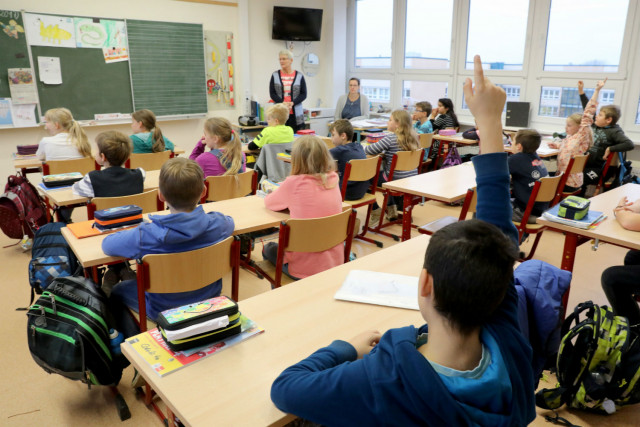
The Kiezdeutsch phenomenon raises many social issues. Photo: DPA
According to Dittmar, another significant feature of Kiezdeutsch is Koronaliserung: the pronunciation of ‘ch’ as ‘sch’. Nicht becomes nisch, and mich becomes misch, for instance. Dittmar suggests that this linguistic feature is like a stamp of identity among Kiezdeutsch speakers.
“This phonetic variation is most often found amongst young people from uneducated backgrounds, who have less contact with young people from ethnic German backgrounds, and so often understand this clear feature as a distinctive symbol of their identity,” he told The Local
But, Dittmar further argues, it is also a negative sociolinguistic stereotype of young migrants in society: a stereotype which portrays them as uneducated and poorly integrated. And it’s a stereotype which is unjustified.
As early as the 19th century, the ‘sch’ sound was being used in middle German towns. Moreover, the variation does not inhibit understanding. Instead, Dittmar suggests, it’s a way for Germans to determine that ‘the speaker really isn’t native’, ‘that he or she is distancing themselves from us, the normal German speakers.’
Debate around Kiezdeutsch can thus be considered as reflective of questions of immigration and integration, rather as threatening to the German language. Kiezdeutsch is not the only Kontaktsprache; comparable phenomena are apparent in countries such as the Netherlands, Sweden and Denmark where there are similarly high levels of immigration.
Furthermore, spoken languages always tend towards simplification, as even native speakers abbreviate and omit longer grammatical structures for ease’s sake. Linguists thus argue that Kiezdeutsch will not do long term damage to German; rather, it should be viewed as innovative broadening of Standarddeutsch.
Comments