
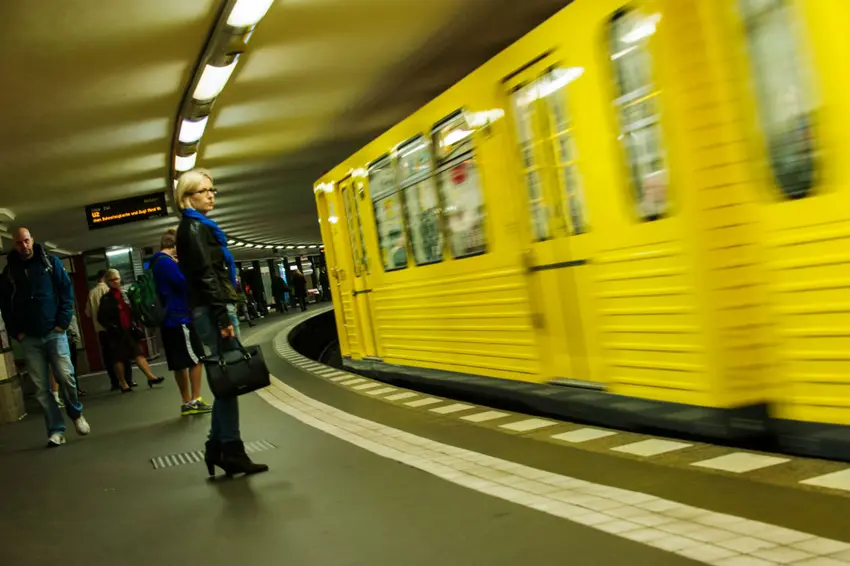
If you have impatiently been tapping your foot over recent weeks waiting for an U-Bahn train that never seems to arrive, you haven’t just got a case of the Berlin winter blues.
The service on the Berlin underground has become so poor that things have reached a “crisis”, Jens Wieseke, spokesman for IBEG said on Tuesday.
Across the entire network, trains are running at more irregular intervals, are shorter and are turning up with malfunctioning doors, explained Wieseke.
“Really, no train is supposed to be put into service with graffiti on it. But they can’t spare the trains for the time it takes to clean the paint off, so now carriages covered in graffiti are also being used,” says Wieseke.
“You can’t narrow it down to just one or two lines,” he says. “The problems are surfacing across the whole U-Bahn network.”
Wieseke explains that the average train on the Berlin U-Bahn network is 30 years old. “That is when a train should normally be sent for scrap, so it really says something if that is the average age of a train being used in Berlin.”
“On the U55 line they have started using trains again that were sold to North Korea and were put out of service two decades ago. I might want to see these when I visit a museum, but not on my way to work.”
According to Wieseke the situation has been getting worse for years “but it has been dramatically worse since the summer.”
While he says that for several years the Berlin Transport Company (BVG) managed to paper over the cracks by refurbishing trains from the pre-First World War lines (U1-U4) for the more modern routes (U5-U9), the trains "are now at the end of their lives - the time of magic tricks is over."
The BVG confirmed to The Local that “due to the continually rising number of passengers” their trains are “increasingly put under strain.”
But the company also claimed that “the punctuality of our trains is very good in international comparison.”
Moreover the company added that “the U-Bahn is by some degree the most reliable mode of transport in the city. The cancellation quota in 2016 was under one percent.”
Reinforcements on the way?
The BVG also emphasize that they are taking action.
At the start of November the company announced that they had ordered 20 new trains from the Swiss company Stadler to a value of €120 million, with the first planned to enter service in the second half of 2019.
So eager were the BVG to purchase the trains, that they ordered them without going through the normal procedures.
Instead of opening a bidding process across the EU, the company gave the contract directly to Stadler, claiming this measure was forced upon them by an “unforeseeable and substantial wear-out of the current U-Bahn carriages.”
But this reasoning hasn’t been accepted by German industrial giant Siemens, which announced on Monday that it would take legal action against the Stadler contract. According to Siemens, the current trains are still in a good enough state of repair to withstand the extra months that would have been involved in the bidding process.
While a court looks at the case, Stadler is not permitted to start building the new trains.
According to Wieseke, the BVG should have addressed problem six years ago.
“Buying a train is not like buying a car, it takes time to build them,” he says. “The trains have now reached the end of their lives.”
If the Stadler order is held up in the courts “the situation will become really dramatic,” he warns.
Berlin daily Tagesspiegel also reports that the BVG ignored the problem for years, choosing not to spend any extra money on renewing its fleet despite knowing that the aging trains were becoming ever less reliable.
Comments