
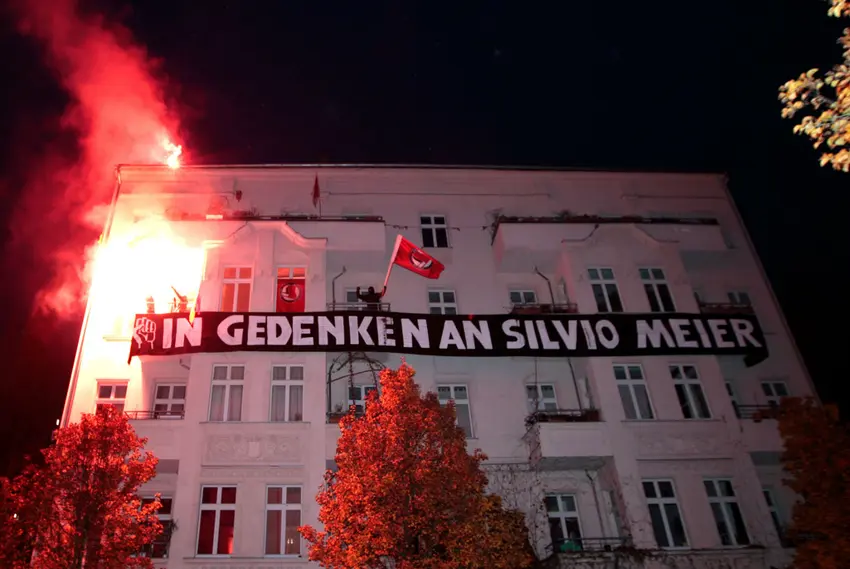
The evening of November 21st, 1992, is seared into my memory. I was in my apartment in the Berlin district of Mitte, listening to radio station DT64, which reported vaguely about a dust-up between right-wingers and the local leftist scene near the Samariterstrasse U-Bahn stop in Friedrichshain.
It was completely unclear what had happened, but I hadn’t seen my friends at the 47 Schreinerstrasse squat for a while, so I headed over for a visit and, of course, to get the inside scoop on what had gone down.
As I exited the U-Bahn station at the corner of Samariterstrasse and Frankfurter Allee, I spied a luminescent candle-lit vigil at the top of the stairs, a handful of teenage punks sitting cross-legged around it.
“Hier wurde Silvio von Nazis ermordet,” (Silvio was murdered here by Nazis) read a cardboard sign taped to the wall. I gasped in disbelief. “Silvio Meier?! From 47 Schreinerstrasse?,“ I pressed them, fearing the answer. They nodded. I doubled over, my insides cramping as if I’d been rammed in the stomach. One of the punk kids, not 16 years old, rose to give me a hug.
Slowly, the details came out. The previous night, Silvio Meier, a 27-year-old printer from Berlin’s anarcho-antifa scene, had been out with friends. Leaving the U-Bahn station at around midnight, they ran into a gang of six or seven young Nazi skins; insults were exchanged, fists flew, and then the skins pulled knives.
They stabbed Silvio in the chest, and slashed two others. Silvio dropped to the ground, as did Ekkehard S., who was kicked in the head until he lost consciousness. The right-wing teenagers fled the bloody crime scene. By the time the ambulance reached the hospital in the wee hours of November 21st, Silvio was dead.
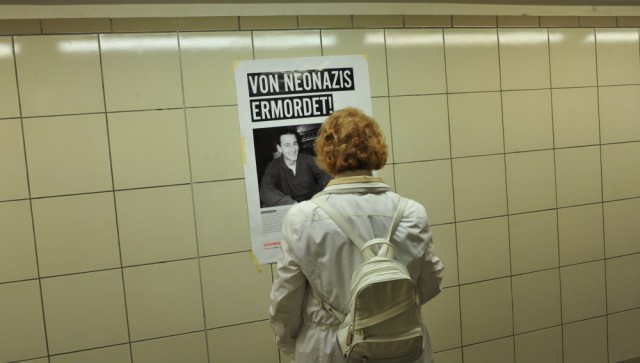 A woman looks at a memorial to Meier in 2014. Photo: DPA
Silvio was a charismatic, small-framed guy with lofty ideals, and a known figure in squatter circles, not least for his work at Hinkelstein Druckerei, the scene’s go-to printing press. But most of the F’hain bohème probably didn’t know Silvio’s background or the story of Kirche von Unten (Church from Below), an anarcho-dissident group from the days of communist East Germany (GDR), which lent a hand to the felling of the Berlin Wall. It’s not a story you’ll find in today’s history books.
Meier moved to East Berlin from his home town of Quedlinburg in 1986. He didn’t know many people, but he met like-minded punks and free thinkers at the underground club, Leichenkeller (Corpse Celler), behind the Erlöserkirche in Lichtenberg. There the informal circles – among them many draft resisters -- didn’t accept the so-called “socialism” of the GDR, nor did they long for the West’s capitalist consumer society. They wanted a grassroots socialism worthy of the name: one more egalitarian than the GDR with a radical democracy more hands-on than that in West Germany.
Try as Meier’s small clique did, it couldn’t get much of anything off the ground with their sporadic access to the subterranean, three-room Corpse Cellar. Local cafes booted them out, the churches harboured them only grudgingly. Silvio though became the scene’s man for organizing underground concerts for critically minded bands not allowed on the GDR’s stages. Testimony to his people skills, he even managed to get West German bands like Element of Crime to play volunteer gigs in the nave of the Church of Zion on Mitte’s Zionskirchplatz.
Meier along with samizdat-writer Dirk Moldt, GDR punk legend Speiche, and peace activist Kathrin Kadasch, among others, lobbied the church with all their might to lend them space of their own in one of the parishes, threatening even to hold a hunger strike in a church if they didn’t get it.
The church eventually gave in, granting the unauthorized group Kirche von Unten, called to life in 1987, two rooms in the back of the St. Elisabeth Church parish on Invalidenstrasse. They called their new digs “KvU” and from its premises, which included a long, wooden bar and performance space painted red and black, they launched one event after another – every one of which delegitimized the ostensibly all-controlling regime.
Church from Below and a few other like-minded splinter groups even organized independent election monitoring in May 1989 that called the state out on its fraudulent, fake votes, a key moment in the course of 1989 that ultimately led to the fall of the Berlin Wall.
An issue they couldn’t circumvent was that of the GDR’s neo-Nazi subculture: racist militants, usually with shaven heads, jackboots, and bomber jackets – who’d terrorize the leftist punks at any opportunity. Since the GDR considered itself an “anti-fascist state,” it was loath to admit the neo-Nazis existed, even though they’d arrested them for vandalizing Jewish cemeteries and spraying swastikas on the GDR’s walls.
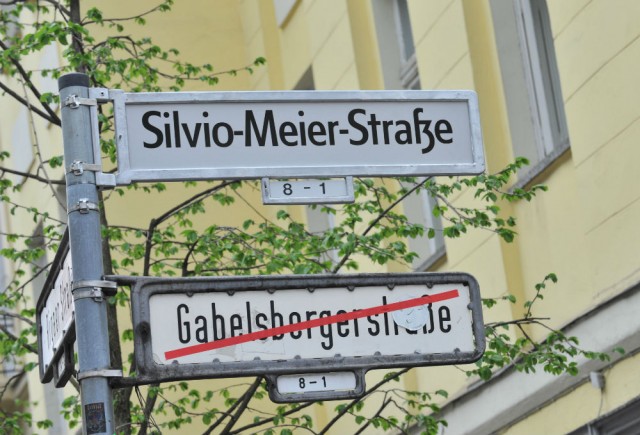 A street is named after Meier in 2013. Photo: DPA
When the Wall was finally breached on November 9th, 1989, Silvio and his fellow denizens from Church from Below squatted Schreinerstrasse 47, one of the old Mietsbaraken near the Samariter Church. They were the first to squat a building in East Berlin, setting off a wave of occupations that numbered over one hundred by mid-1990. Yet, despite the freewheeling, anarchic creativity unleashed by communism’s collapse, the squatter community had to confront a neo-Nazi scene that had exploded in numbers – and audacity – since the Wall’s fall.
I remember the grave concern in the squats, art houses, and night spots in the early 1990s. No one looking “alternative” in appearance walked the streets alone. The squats bordered up their lower windows. A hotline was set up and defense committees to repel skinhead attacks. The rightists also laid siege to refugee hostels, terrorizing and even killing people. In 1990 and 91, 21 people were killed by right-wing extremists.
Silvio was at the front of antifa campaigns in Friedrichshain, which didn’t get much help from the police who tended to lump leftists and rightists in the same pot. The authorities had no strategy to deal with the neo-Nazi groups that tended to hail from the plattenbau highrise districts in Berlin’s east, such as Lichtenberg, which abuts Friedrichshain, and was the home of Silvio’s killer.
On the evening of November 22nd, 1991, a hundred or so people gathered outside of Schrienerstrasse 47 with the intention of marching into Lichtenberg. I was part of the demonstration that made its way through the streets to the youth club known as a meeting point of the skinheads and other neo-Nazis. The building was vacant but we broke in and tried our best to ransack it. But even the curtains, made of plastic, wouldn’t burn. The thick plexiglass windows didn’t break.
A year later the murderer, a 17-year-old, was sentenced to four years’ imprisonment. Many of the original Church from Below members left Berlin, relocating as far from Germany as they could.
Every year since the 1992 march, there‘s been an antifa-antiracism demo that winds its way through Friedrichshain – and sometimes into Lichtenburg. At its front is usually Chrischi, Silvio’s widow, and his 26-year-old son. This year’s will be on November 25th at 17:00, leaving from U-Bahnhof Samariterstraße.
Paul Hockenos recently authored a book "Berlin Calling: A Story of Anarchy, Music, the Wall and the Birth of the New Berlin" about the German capital at the time of the Wende.
Comments