
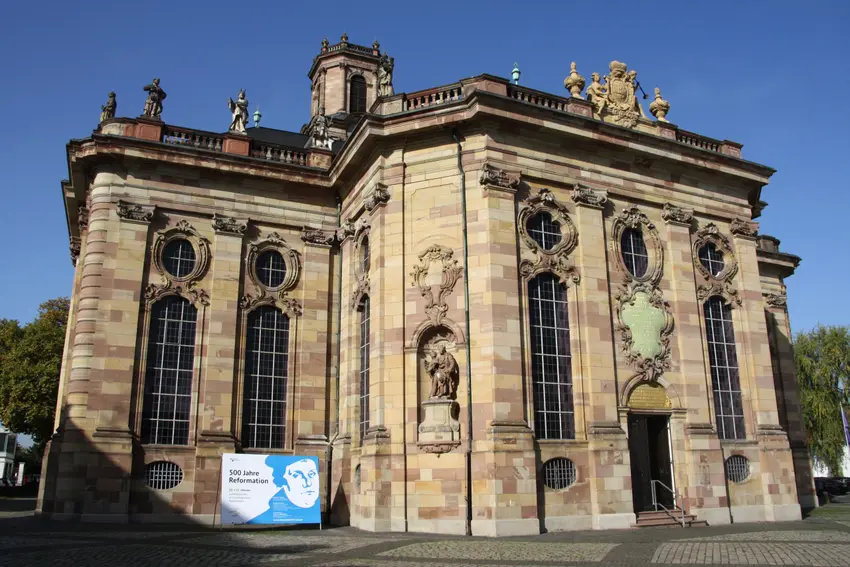
With a population of just over one million, and its capital of Saarbrücken attracting less international acclaim than other larger German cities, Saarland may have never been on your radar before.
But following its state election this Sunday, we've updated this story from our archive to give you a bit of background on the small yet fascinating state in western Germany.
Saarland has a long history with neighbouring France
The region’s first inhabitants up to the Middle Ages were Celts and Germanic Franks, and it was often inhabited by German-speakers. But today's Saarland also was long influenced by the French, especially after it became a French province in 1684.
The area known as “Saar” would go back and forth under French or some other rule for years to come after that, until Napoleon Bonaparte’s defeat in 1815 when most of it was ceded to Prussia.
It’s largest modern-day border is still with France, with Luxembourg also to its west. France and the French language are still quite important to the region, and the state government in 2014 announced it wanted to become fully bilingual by 2043, making French its second common language spoken by all.
France is also the state’s most important trading partner for iron, sheet metal, coal, and other industrial materials.
It voted to join the Third Reich in 1935
After the end of the First World War, Saarland was placed under the administration of the League of Nations and for 15 years was its own political entity with its own currency and stamps.
Then in 1935, the locals voted overwhelmingly to be part of the Third Reich with more than 90 percent support in a referendum.
It also voted to join West Germany after the Second World War
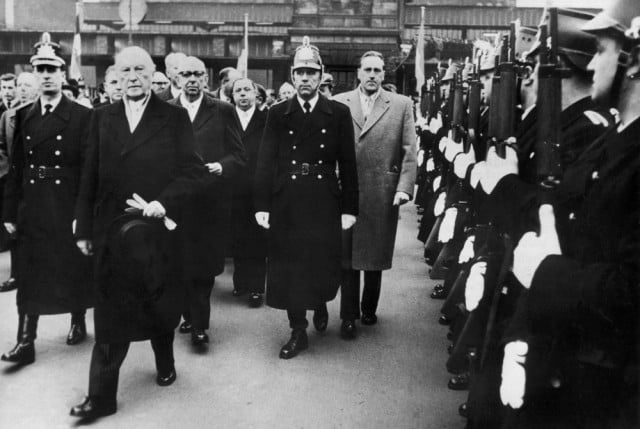 Chancellor Konrad Adenauer in Saarland on January 1st, 1957, when the state joined West Germany. Photo: DPA.
After the Second World War, the Allied powers occupied Germany, splitting the country into zones of responsibility under the UK, US, France and the Soviet Union.
Saarland was occupied by the French and continued to be the Saar Protectorate under France when the other west-occupied regions merged to form the Federal Republic of Germany (West Germany) in 1949 during the Cold War.
France had offered to establish Saarland as an independent state, but the population voted against this plan in 1955, which was essentially a vote in support of the region joining West German instead.
It wasn’t until 1957 that the French and West German governments implemented a treaty to allow Saarland to join the other western states under the Federal Republic. This is known as the “Little Reunification” - Kleine Wiedervereinigung - in German, and was the most significant border change in Europe until the fall of the Berlin Wall.
It has mostly been governed by the CDU party
Since Saarland’s first state parliament elections in 1960 after joining West Germany, the conservative CDU has mostly governed the state as the largest party, except for between 1980 and the 1999 elections when the the Social Democrats (SPD) took power - and of course the SPD - under the leadership of Chancellor Olaf Scholz - are currently on course for a huge victory in the 2022 state election.
At the last Saarland election in 2017, the CDU came out on top and had been governing regionally in a power-sharing coalition with the SPD.
READ MORE: Social Democrats clear first election test with win in Saarland
Their dialect often refers to women and girls as ‘it’
The Saarland state website is quick to point out that they don’t have just one single dialect. Instead, people speak either Rhine Franconian or Moselle Franconian.
“There is no united Saarland dialect,” the state website insists. “That is to say that Saarland speaks many dialects.”
And one thing in particular about the local dialects is that people often refer to all women and girls in the neutral, or “it”, form.
One theory behind this is that it comes from women’s names and references taking on the diminutive form. German has three genders - feminine, masculine, and neuter - and women are usually referred to in the feminine in Standard German. But when nouns are in the diminutive - like Mädchen for girl or calling a woman Anne “Annchen" they become neuter. And this is apparently the reason behind Saarlanders calling all women and girls “it”.
But some researchers have said this explanation is too simple, suggesting instead that the neutral form is a way to show more familiarity or proximity to the person you’re speaking with. Linguist Damaris Nübling observed last year that women who were unfamiliar to the speaker were still referred to in the feminine form, the Frankfurter Allgemeine Zeitung reported.
It's home to two of Germany's absolute best restaurants
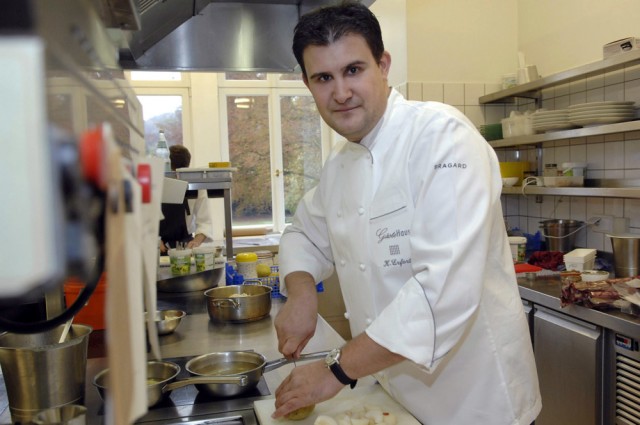 Three-star chef Klaus Erfort. Photo: DPA.
For such a small state, Saarland actually has more three-star Michelin restaurants than Berlin or Munich. There's Victor's Fine Dining by Christian Bau in Perl, which is housed in an old castle and blends elements of both Eastern and Western cuisine.
And there's also GästeHaus Klaus Erfort in the capital of Saarbrücken, which specializes in French cuisine.
Comments