
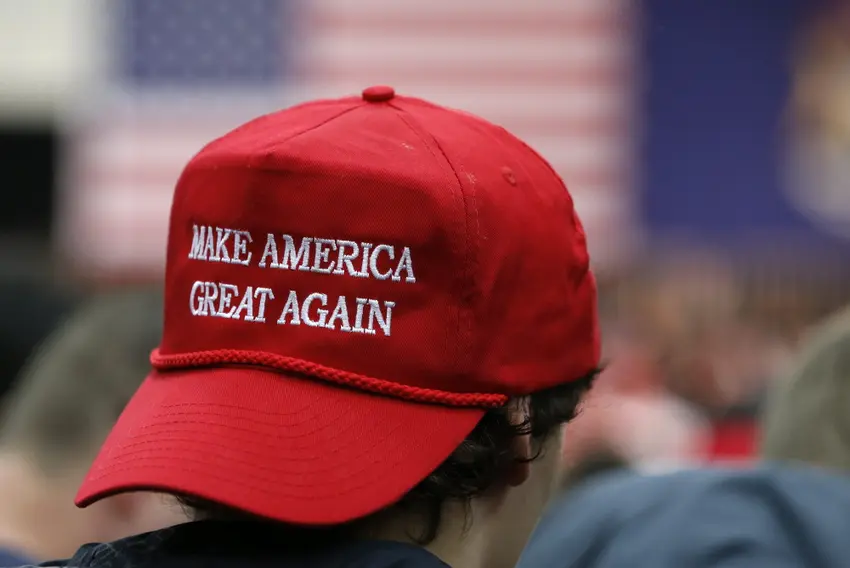
Since Trump was elected in November, he has already established a rocky relationship with Germany, despite having not yet made a presidential visit to the country.
Polls have shown most Germans are “afraid” of Trump; Germany’s own President-elect once called him a “hate preacher”; and this year’s round of Carnival floats took joy in quite brutally mocking the American Commander in Chief.
So for Republicans in Germany, the experience living here has been, to say the least, interesting.
“If you go out socially and the topic turns political, you hear that Republicans don’t always feel comfortable. I tend to downplay it [being a Republican] for fear that someone won’t understand that there can be big differences in opinions [in the party],” explains Thomas Leiser, a Texan transplant in the Frankfurt area who leads the German Republicans Overseas branch.
“Before the election, some people would make sure to do very little to publicize that they were Republican for fear of backlash at work or with business counterparts.
“I think that remains this year and it was less so before [Trump]. It seems the sentiment is more polarizing this go around than the prior two elections.”
Established in 2013, Republicans Overseas succeeded the previous Republicans Abroad group, and currently has about 1,000 members in Germany, according to Leiser. The group can at times be overshadowed by the larger, more outspoken Democrats Abroad, who have more than 1,200 Facebook followers in Berlin alone.
“If the [German] attitude were less skewed, I think we would become much more vocal, less invisible,” Leiser tells The Local.
“But still, I don’t think we would ever go out of our way to become super prominent.”
Part of the Republican group’s smaller presence in Germany may also be due to its different standing compared to the Democrat group: Democrats Abroad is an official arm of its party, and its members can even vote from abroad in national primary elections as a sort of extra state with their own delegates attending the Democratic National Convention.
Divisive politics
Trump’s presidency has been divisive within the Republican party both abroad and at home from the start. His controversial travel ban, which caused great consternation among German politicians, also was opposed by at least two dozen Republican members of Congress.
Just this week, the real estate mogul’s budget plan received criticism from top party members like Senator Lindsey Graham, while Senate Majority Leader Mitch McConnell said his proposed cuts would “probably not” pass Congress.
Leiser explained that among Republicans Overseas members, there has been a lot of variation in how people view Trump.
“I tend to be less agreeable with how things are running,” Leiser said. “And there are some members, who are intelligent and well-educated, who seem to think he’s done everything absolutely right.”
Group vice president Ralph Freund states outright that he’s a Trump supporter - though also critical of the president. As a German, he often goes on national talk shows to explain his and the party’s perspective.
“With regard to Republican values and attitudes, I think they have better answers to the current problems,” Freund tells The Local.
“I’m a minority in Germany as a Republican… Outside of Frankfurt and my business I can get lonely. But that’s why I have to stand up and explain the Republican party.”
And while Leiser noted that some Republican members have felt less inclined to talk about Trump in Germany, Freund says the new president has in fact given him a bigger voice in the German media as his country clamours for a better understanding of the unconventional US leader.
“I don’t think I would have gotten this much media attention if it were President Marco Rubio,” he said, referring to the former Floridian presidential hopeful.
“For me it’s fabulous, it’s such an experience,” he added, though he did admit that he almost lost a friend due to his support for Trump.
“She was so disgusted, so I had to go and explain everything.”
Translating Trump to the Germans
A poll released ahead of Trump’s inauguration showed that most Germans thought of Trump as either “dangerous”, “irresponsible”, or “unpredictable” - hardly optimistic results.
So part of what Freund says he does on German news shows is to try to calm some of the Germans’ jitters.
“He will not govern like someone from a third world country. People compare him to Putin or Erdogan, which he is not,” Freund said.
“I’m trying to get this feeling, and shock and disappointment, out of people’s heads.”
Leiser also said he’s observed how Germans often struggle to understand Trump and the American political system.
“It’s too early to condemn everything, but it’s not too early to say ‘I’m confused’.”
“The Germans who like things very laid out and in a logical manner have a difficult time comprehending what’s at hand,” Leiser said. “On the other hand, if you look at Ronald Reagan, some of the comments were exactly the same: ‘You can’t have a cowboy actor as president. How can he do anything for Germany?’ And yet I think he was one of the best presidents for Germany.
Both he and Freund said Germans should have a bit more patience with the new administration.
“I spend a lot of my time trying to explain that you’ve got to give some time for everyone to figure out which way is up and which way is down,” Leiser said.
“In the US, there’s always one party or the other, and this gives rise to extreme, abrupt changes and procedures like we’re seeing today. When [George W.] Bush left office and Obama came, there were significant changes.”
Freund said that while Trump opponents should remain critical, they also should wait to see what else he does.
“Read his lips, look at him carefully, but let him work and let him deliver,” he emphasized.
“If he fails, then blame me and the Republican party, but until then let him work.”
Comments