
The poll published on Wednesday by Pew Research Centre asked participants whether they agreed that “having been born in our country is very important for being truly German”. Just 13 percent said yes.
The US, where President Donald Trump’s recent temporary travel bans have stirred up debate about identity, saw more than twice the amount of people who said birth had a lot to do with being “truly American”, at 32 percent.
But respondents from other countries were even more focused on birthplace: 52 percent of Hungarians, 50 percent of Greeks and 50 percent of Japanese respondents said where one is born is a big factor in whether they can be considered part of the gang.
“Debates over what it means to be a ‘true’ American, Australian, German or other nationality have often highlighted the importance of a person being born in a particular country,” the report states.
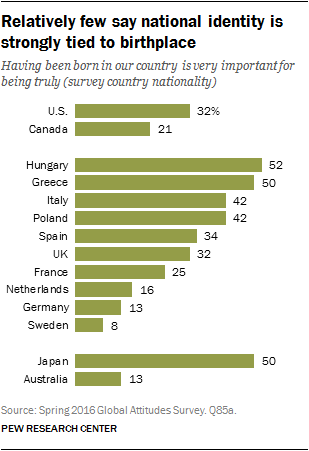
“But contrary to such rhetoric, [the] survey finds that people generally place a relatively low premium on a person’s birthplace.”
The survey was conducted between April and May of last year with more than 14,000 respondents across 14 countries.
The research centre also found that language was a much stronger factor in whether someone could lay claim to a national identity. Nearly 80 percent of Germans said speaking Deutsch is important for being considered German. Only the Netherlands (84 percent), Hungary (81 percent) and the UK (81 percent) had higher proportions of people who felt similarly about their own native tongues.
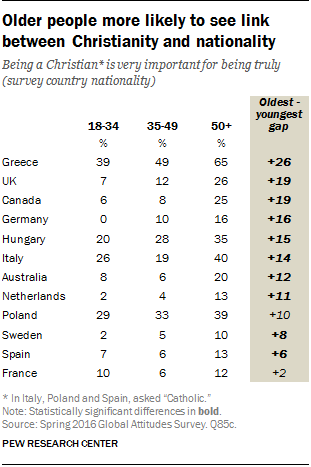
In the US, 70 percent said being able to speak English was very important for “true Americans”, while about one-third said being Christian was also quite a significant requirement. Just 11 percent of Germans felt that being Christian was key to being included in the national identity.
Younger generations seemed more flexible across countries in their criteria for identity. For example, no Germans between 18 and 34 said that Christianity was significant for being German. But 16 percent of those over 50 said it was very important.
“Across the countries surveyed, there are significant differences in how the youngest and oldest generations view national identity,” the report states, adding that the old are more likely than the young to say birthplace is very important for identity.
And supporters of Germany’s far-right Alternative for Germany party (AfD) were more likely to say that sharing German customs and traditions made someone “truly German”. Nearly half of those who favoured the AfD said traditions were key, while just one-fourth of those who didn’t like the AfD said the same.
“In many countries, the debate over national identity is a partisan one,” according to the Pew report.
“In some countries, there is also an ideological divide over the relationship between culture and nationality, with those on the right significantly more likely than those on the left to link the two.”
Comments