
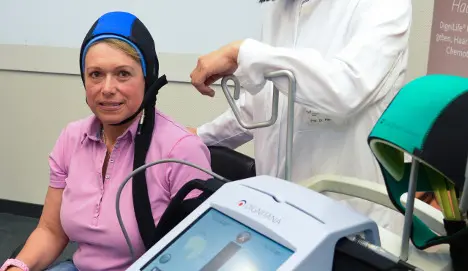
The Hanover Medical College (MHH) has been testing the silicon-based caps for the past year.
“We were pretty sceptical to begin with, but we’ve been stunned by the results,” said the deputy director of MHH’s women’s clinic, Tyoung-Won Park-Simon, on Wednesday.
So far 19 breast cancer patients have undergone chemotherapy while using the caps.
Sabine G. who was diagnosed with cancer in September 2014, immediately took up the option.
“Of course, the first question is always ‘Will i get better again?’ But for me the second question was ‘can I keep my hair?’ said the 48-year-old from Hanover.
“It worked well for me. My hair got thinner but I never needed a hat or a headscarf.”
But the effects vary. The cap didn't help all the women keep as much of their hair. And the treatment doesn’t work for all tumor types.
According to the German Cancer Information Service (KID), many women call them up inquiring about types of chemotherapy which diminish hair-loss.
“Various manufacturers have developed cool-caps for some time,” said Birgit Hiller from KID. “But until now it couldn’t be confirmed that the technology had positive effects for all, or at least most cancer patients.”
The patient wears the silicone cap during the infusion of the anti-cancer drugs. The cap keeps the patient’s hair at a steady temperature between 3-5 Celsius.
Local blood vessels become narrower in the cold, making it harder for the medicine to reach this part of the body.
There is so far no evidence that the caps are harmful, although some patients have complained about headaches.
But Sabine G. said that the cap was a huge bonus for her as it meant people couldn’t tell she had cancer.
“It really helped me out. I could decide who I wanted to speak to about my cancer,” she said.
Comments