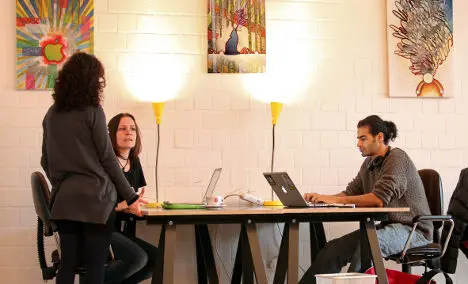
On the second floor of a renovated factory in Berlin’s trendy Kreuzberg district, an eclectic bunch of freelancers and entrepreneurs hunch over laptops in a peculiar hybrid of a traditional office, a home workspace and a coffee shop.
A row of alphabetized pigeon holes serve as mailboxes for the “office” workers. People mill around the small kitchen area chatting and brewing coffee. Groups of young professionals, collaborating on shared projects, gather around desks pushed together like a flotilla of pontoons, while lone-wolf freelancers tap away on their laptops at separate work stations.
The space gently hums with a laid-back, convivial hubbub of activity. Welcome to a new way of working in Germany. Welcome to the Betahaus.
Everyone she passes greets Madeleine von Mohl with a cheery, “Hallo!” The genial thirty-something, from a small town northeast of Hamburg, seems to know each one of the 150 people who rent desks at the Betahaus.
Von Mohl is one of six like-minded entrepreneurs who co-founded the pioneering venture in April 2009, the first of its kind in the German capital. But now such “co-working spaces” are popping up all over the country, from Berlin to Stuttgart, Munich to Cologne and beyond. Von Mohl hit upon the idea when she wanted to find a better environment for herself and her friends to work and collaborate.
“Five or ten years ago, the most freedom anyone could have was to work at home. It was the ideal scenario. Everybody wanted to have a home office,” von Mohl said.
Not anymore. These days, a growing tribe of self-employed laptop nomads are looking to get out of the house and back into the world at large.
Both telecommuting professionals and footloose freelancers are discovering that working alone at home, in a lonely office, or in a coffee shop isn’t all it’s cracked up to be. There are often too many distractions, too much noise; and working in isolation can cause motivation to dip.
No more napping
People find they become less effective, less productive in such working environments. They yearn for the social interaction, professionalism and synergy found at a traditional office, albeit one with a modern, maverick spin.
“We think we combine the positive sides of a traditional company – you have colleagues you can say, ‘Good morning’ to, every day – with an infrastructure that works,” von Mohl said. “And we’re open to all: we don’t say to specific people, ‘You’re not allowed to enter.’”
Co-working spaces are providing a 21st century techie twist on the old idea of shared artists’ studios. It’s cheaper than leasing traditional office space. And it rescues people who might otherwise sit in their pyjamas at home all day or find themselves in cafés nursing a stone-cold latte macchiato.
“Having a consistent, reliable place to go to work is good for keeping your head straight,” says Stefan Müller, 31, a freelance software developer from Frankurt. “It helps me separate home from work and I find I can focus better here.”
Stefan rents a “flex-desk” at Betahaus at a monthly rate, which allows him to work at any available desk in the building.
Depending on their needs, other people rent fixed desks or team desks. The fourth floor houses a new area dedicated to nascent firms. Betahaus runs a competition called “Betapitch,” which invites aspiring start-ups to put forward their business proposals. The winning pitch receives six months’ free office space in the Betahaus.
Like most co-working spaces, Betahaus offers everything you’d find in a traditional office – internet, printers, lockers, the use of meeting rooms – and a few unconventional extras. A hairdresser will be on site every Friday for those needing a quick trim ahead of a weekend of Berlin partying or for that crucial business meeting. And a Hong Kong tailor will sometimes swing by to measure up fashion-conscious Betahausers for bespoke suits.
Every Thursday morning, in the ground floor café which doubles as a meeting place and foyer for the Betahaus, von Mohl hosts the “Beta breakfast,” where members gather to shoot the breeze away from their desks over a spot of Frühstuck. An informal presentation provides the weekly entertainment and offers an opportunity to network and share ideas.
In the summer of 2010, Betahaus opened its second branch in Hamburg’s hip Schanzenviertel district. A third space will open its doors to Cologne’s transient workforce on May 1 this year. But the expansion plans don’t end in Germany.
Betahaus is renovating a house in Lisbon (where von Mohl studied at university and met fellow co-founder Christoph Fahle) that will serve as new premises. A suitable location in Barcelona is also being sought. Eastern Europe is next, with Bucharest already pencilled in.
“We sometimes think we’re the winner from the economic crisis,” von Mohl said.
Diff'rent strokes
A different kind of co-working space in Berlin is Wostel, located on the cutting-edge of Neukölln’s burgeoning creative scene. The ambitions of founders Marie Jacobi, a designer, and Chuente Noufena, a graduate in business management, are more local than Betahaus’ Europe-wide franchise.
“It’s Neukölln. It’s hot right now. We’re in the middle of these changes here,” Jacobi said. “It was important for us to be on street-level. We want to be connected to the life on the street: otherwise you’re just connected to the internet.”
Their philosophy is closer to the spirit of the original movement started by computer programmer Brad Neuberg in San Francisco in 2005, whereby creating a community of co-workers with shared values was more important than profit.
“We wanted people to have a special place to work; not like the other places which are a little Ikea,” Noufena said.
Unlike the ramshackle corporate interior of Betahaus, Wostel has the elegant ambiance of a 1960s classroom from the TV show Mad Men. It contains a hotchpotch of mismatching desks and chairs and retro knick knacks in classic Berlin style and plays host to a changing cast of itinerant coworkers.
The dimly-lit “red room” at the back of the Wostel – with blood-soaked décor straight out of a David Lynch movie – has proven popular with freelance writers who need a quiet space to concentrate.
“It might not last,” Jacobi said. “Maybe people will want to work alone again? Return home!”
Do you have any other German workplace tips? Add them to the comments section below.
Comments