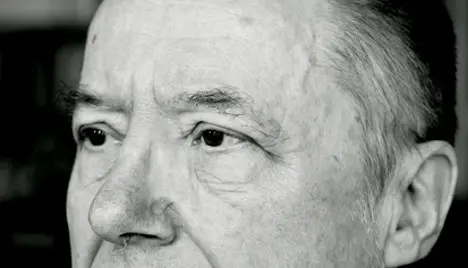
“This reminds me of the mug shots they took of the Polish children,” says Guntram Weber, 67, as he’s being photographed. He acquiesces patiently though, posing this way and that – no model, but a man bred to the ‘purely beautiful’ – the child and pride of the bygone utopia of a pure Aryan world.
His genes, in fact, were once amongst Germany’s most prized, but his parentage remained a mystery to him for decades. Born in 1943 in the Third Reich’s Posen (now Poznan in Poland), Weber is a child of Lebensborn, one of National Socialism’s most insidious schemes.
“As a child I remember sensing that I wasn’t quite normal,” he says softly, his tall, angular frame perched on the sofa of his homely Kreuzberg flat. “Family members treated me awkwardly.” His mother was ‘his rock’, but he soon realised her husband was his stepfather, not his biological one. The ensuing insecurity consumed his youth but this was not unusual for a generation shorn of fathers. However the details he would later discover on his identity most certainly were.
Aryan breeding programme
Lebensborn, ‘spring of life’ in old German, was a programme founded in 1935 aimed at increasing birth rates of Aryan children in the Third Reich. SS officers and other high-ranking Nazis with demonstrable Aryan pedigree were encouraged to sow their seed beyond marriages to create a blue-eyed and blonde-haired master race to perpetuate Adolf Hitler’s Germania. As SS leader Heinrich Himmler, the Lebensborn founder and a key figure in Weber’s life, said: “I want to save every drop of good German blood.”
This meant establishing a network of 26 maternity homes in German territory where racially ‘pure’ mothers could give birth to illegitimate children sired by SS lovers away from society’s stigmatising glare. Though lurid tales of breeding farms are wide of the mark, the homes provided a refuge for young women – if they could prove heritage back to their grandfather.
Children were conceived out of love, by mistake or through naivety. Other women certainly conceived on ideological grounds, but for many the choice was a pragmatic one: the promise of support and secrecy from prying eyes in a conservative society. Mothers would slip off to the homes to give birth discreetly.
There, they enjoyed the best medical facilities and ration-busting supplies of food while their children suffered a harsh welcome to the world, modelled on the Spartan practice of exposure greatly admired by Hitler. “You were separated from your mother as soon as you were born and kept away from her for the first 24 hours of your life,” Weber later learned. “Then you would only be given back to her for 20 minutes every four hours and during that time she was strongly discouraged from talking to you or caressing you.”
Children would spend their earliest months or years at the homes in what amounted to being the Third Reich’s crèche, receiving an SS education while awaiting adoption by SS families if their single mothers did not want them. As the war progressed they were joined by Aryan-looking Polish children forcibly sent back from the front to be ‘Germanised’.
As Weber’s mother once told him in an unguarded moment: “The relationship between mother and child is a power struggle.” For the SS, a child’s will existed only to be broken.
Kept in the dark
It is a miracle that Weber has a story to recount at all. Without the will to surmount feelings of shame and persevere in his search for answers, he would still be in the dark that characterised most of his life. Even today, tears fill his eyes when he describes the constant struggle he faced, searching for the truth but running scared from it, desperate to dispel lies but aching for an ostensibly normal family life with his parents and siblings: an older sister and half brother born after the war.
Growing up, Weber remembers the subject of his real father was taboo. Extended family members had been well-drilled by his mother to conceal the truth, explains Weber. “‘It was the war,’ they would say. ‘Things were very confusing. We didn’t see much of each other – you will have to ask her.’” It wasn’t until he turned 13 that his mother agreed to tell him his father’s story. “‘Well Guntram,’ she said,” Weber remembers. “‘You are old enough to know the truth about your father now.’ Then she gave me a name, told me when his birthday was, when they’d been married, and that my father had been a truck driver for the Luftwaffe, far away from the front who had died driving over a landmine. She added that he certainly wasn’t involved in killing anyone.”
This sort of story was doing the rounds in various households around Germany at the time. “I should have been suspicious,” Weber admits. “But so many kids were told lies about what their parents did in the war and it just wasn’t the done thing to question them.”
Curiosity gnawed at him, but his courage to confront doubts waxed and waned. His mother’s story rang increasingly hollow with no photos or documents to back it up and Weber became convinced his father had been a Nazi. Worried, he would inspect his facial features in the mirror and pore over history books in the school library looking for men who bore him some resemblance. For a terrible period he even feared Joseph Goebbels might be his father.
The mysterious silver cup
An incident in his teens brought him closer to a no less-harrowing truth. “My mother had a strongbox in the bottom right-hand corner of her wardrobe. One afternoon when she was out, I decided to look in. I had terrible qualms about it though,” he confesses. “I knew I was breaking the trust between us and she was my only security in the world.” Inside Weber found the first clue to his real identity: a small silver cup.
“We were a fairly poor family at the time,” he explains. “Like many others, my mother had lost everything during the war, so to find a silver object in the house was extremely unusual. I picked it up carefully and discovered my name on it. ‘Oh!’ I thought, ‘what’s this?’ Because there was also another name there. ‘Guntram Heinrich,’ it said. I’d never heard that before. And on the other side it read: ‘From your godfather, Heinrich Himmler.’
It was a revelation Weber could hardly comprehend: “I even told myself this ‘Guntram Heinrich’ must be someone else,” he says. “Besides, I couldn’t ask my mother about it as I had betrayed her trust.”
The silver cup is tarnished now, but Weber swears he will never honour it with a clean, nor shall he ever let it touch his lips. Holding it is troubling enough – the aged artefact is the nearest thing Weber has to an umbilical cord, tethering him to the deeds of men whose boots he was supposed to fill one day. “For a while with my first wife I even used to joke about that,” he says. “‘If Hitler had won, I would have been made Governor of such-and-such a place,’ I would tell her.” By then, Weber had another piece of the puzzle.
More clues and false promises
In 1966, his older sister needed her birth certificate in order to get married. Their mother, obfuscating, said there was no hope of finding it, but an enquiry at her place of birth turned up the unexpected news that she had been born the illegitimate child of an army officer. Her records were miraculously still intact and being four years older than Weber, she realised she had been born in a Lebensborn home. The word entered the siblings’ discourse for the first time.
Weber inferred that he too was one, albeit from a different father, but before he could summon the strength to question his mother, he moved to the US in pursuit of love, staying there for eight years until his wife’s tragic death in a car crash. He returned to Germany with a son of his own and started teaching writing workshops for disadvantaged children in Kreuzberg.
As more information about Lebensborn trickled into the public consciousness, Weber occasionally grappled with the unknowns of his past. In 1982 he decided to confront his mother one day during a long car journey. He pulled off the road and forced his mother from the car. Finally, says Weber, he had her, “where she could not escape”.
Despite her angry protestations stranded by the roadside, “my mother uttered three sentences that I will never forget: Firstly, ‘I don’t want to talk about that.’ Secondly, ‘People will throw dirt at you.’ And thirdly, ‘I will write it all down for you.’ This was a promise. Suddenly I felt OK, knowing she would eventually give me the truth.
“But she didn’t do it,” he says bitterly. “She couldn’t bring herself to do that for me and she died two years later. I’m stark raving mad at her for that.”
Weber runs his fingers through his short, steelcoloured hair, before tucking his hands behind his head and pulling his elbows in around his face for a moment’s security. His arms tense, hinting at the strength it takes to stop the human body simply exploding from pent-up emotion.
Around him stand shelves filled from floor to ceiling with books, reams of paper print outs, dozens of lever arch files – evidence of a painstaking search for answers. It was not until eight years ago though, after several false starts, that Weber finally found the resolve to confront his past, come what may. “The woman I was living with at the time said to me: ‘You have to find your father.’ And she was right. All the energy had gone out of my life, the same way a battery goes flat,” he remembers.
The harrowing truth
Weber began by tentatively writing down his earliest memories, until he worked up the confidence to ask questions he had previously eschewed. He began what he describes as ‘archaeological trips’ to family members, digging a little deeper with each visit.
Time and the death of his mother had softened the attitudes of his aunt and uncle in particular. His uncle’s mention of a “senior officer” reminded Weber of a similar phrase being used by his stepfather.
Weber’s mother had confided in her husband on her deathbed, but he had been a staunch SS man himself. He was impressed with the identity of Weber’s real father and was reluctant to say. “He was seething when I finally called him to ask who this ‘senior officer’ was,” Weber recalls. “‘Senior officer? Your father??’ He barked back at me: ‘He was a general!’ Then came a name. And I just went numb.”
It was a name Weber knew from history lessons (one he does not want in the press). A man who led SS extermination programmes in Poland and Russia, who was sentenced to death for war crimes, and who escaped internment to live his final days in South America. Above all though, he was a father. Weber’s mother had been his secretary during the early 1940s before becoming infatuated with him. She once admitted to her son to having a weakness for men in uniform.
“I’m no Aryan man”
Weber’s discovery stirred conflicting feelings in him.
“I had to struggle with the fact he was a murderer and that was incredibly difficult,” he admits. “I had to check my position vis–à-vis myself: was there any murderous instinct in me, too? It was harrowing.”
Weber had someone though, who he could call a father at last and that, after 60 years of uncertainty, brought him a degree of peace. It has allowed him to regain a little of his energy, and for all his travails he remains a warm and charismatic man.
Just as he is no murderer, Weber also says: “I am no Aryan man.” He is baffled by the Aryan ideal type, a vision of beauty that remains undiminished despite the price paid for it by the Lebensborn children at one end of the scale, and the victims of the Holocaust at the other. It evidently pains Weber to recount that potential adoptive parents in the US still pay a premium to secure a child with blue eyes.
Weber sees beauty instead in multi-cultural Berlin: “It’s a great city!” he enthuses. “The best in Germany because we have managed some kind of integration here. I’ve always felt we should be a country of immigration – that that should be a grand corrective to our old ideological strait jacket. I feel enriched by all the different people here.”
Meanwhile, for all the pseudo-scientific care that went into his conception, there is a blot on his genealogical copybook that Weber most cherishes. A Polish great, great grandfather by the name of Dmowski makes a mockery of his supposed racial purity – and in the 1870s he made a mockery of the Prussians too.
“They tried to draft him for the war against France, but he said: ‘I’m Polish not Prussian and you can fight your own wars!’” says Weber. “He fled to Russia and didn’t come back until the war was over.”
He smiles as he talks about his forebear, the broad smile of a man who does not want to be subjugated by his past. “He makes me feel immensely proud about who I am,” Weber reveals. His eyes, which made him feel inferior and ‘un-German’ as a child, sparkle – his defiantly brown eyes.
For more from Berlin's leading English-language magazine, click the link below.
Comments