
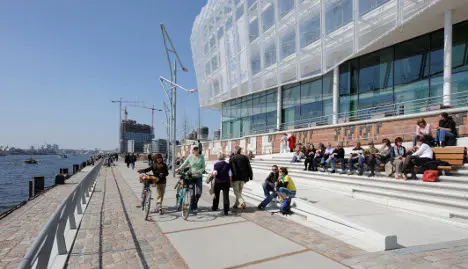
On a recent sunny evening, a group of about thirty people have gathered near Hamburg’s port to explore the new HafenCity district, which will nearly double the size of downtown when finished.
With construction about halfway completed after starting in 2003, there is already plenty to see, including the spectacular Elbe Philharmonic rising steadily atop an old brick warehouse. Horrendously over budget, it is expected to become the northern German city’s new landmark when done in 2012.
For the tour we’re each given an earpiece, so we can listen in as Gerwin Zohlen, an architecture critic from Berlin, and Enrico Santifaller, an architecture journalist and author, both wearing gray suits and proceeding at a stroll while conducting a leisurely conversation about the results, thus far.
“This glass,” says Zohlen, gesturing at a glass-fronted fishbowl residential tower. “Isn’t it an invitation to indecency?”
“Ja,” says Santifaller. With a damning shrug: “It’s design.”
The HafenCity tours, in which two experts lead an hour and half walking tour through the development, with pretzels, wine and a discussion afterwards, began in 2006. There have been between five and seven tours a year since then, and this year’s tour leaders include Tamo Kunz, the set designer for filmmaker Fatih Akin.
They are, say regular attendees, varied, and always interesting. The tours have proven immensely popular, with up to 80 people paying the €8-price of admission. Tonight, the group leaders seem to be mostly in agreement: “Is it pure conservatism to say: I expect a building to have walls?”
“The building gives the impression that it’s floating. The question is: Do I want to live in a house that floats?”
We come to a stop in front of a completed building that draws less ire.
“There’s nothing here to truly criticize…”
“Still, it’s pretty boring.”
A conversation about the drawbacks of commercial real estate leads to a slight difference of opinion. “You can see it in the architecture—the investors have cut all the details,” says Zohlen.
“Ach, I can’t stand all this ‘evil investor’ talk,” says Santifaller. “These architects walk around, saying, ‘I designed the most beautiful building, but they ruined it.’ Architects know what the limitations are, and they should plan for them.”
Zohlen rolls a cigarette and begins to smoke it.
At one of the main squares, with steps leading down to the water, we stop again. “I find the square and the steps good--ok, a little too big, it could be more intimate,” says Zohlen.
“These lamps are supposed to be cranes,” says Santifaller.
“Oh god, oh god, oh god,”
“Why can’t you just have a normal, nice lamp? That would have been fine, instead of these funny design ones.”
The thoroughly enjoyable banter continues as they group passes through a construction area and almost gets run over by a bus. “This graphic—if you turn them a little, it looks a swastika…”
“The windows look like they’re from Baumarkt…”
“Look at this! The stone façade doesn’t reach the ground”
“Ah! A gap! That’s very embarrassing.”
“The sandstone is nice,”
“But paper thin”
“The public will swallow anything…”
“It’s not the nicest specimen”
“I don’t like this glass façade: I like to touch things and this I don’t want to touch. I know my soul will slide right off.”
“Why can’t you make a building out of wood?”
“I agree.”
As the sun sets and we come to the end of the walk (“You can see right into that bedroom,” “I don’t want people to see into my bedroom!”), the two men wrap up the discussion. “In conclusion,” says Zohlen, “I think HafenCity is, on the whole, very successful.”
“Yes,” agrees Santifaller, as the light on the Elbe turns pink. “It’s comforting to know that we are capable of producing a successful urban space, today.”
More information: The remaining 2010 walks will take place July 14, August 18, August 25, September 1, and September 15. Meet at 6:30 pm at HafenCity InfoCenter im Kesselhaus, Am Sandtorkai 30. Reserve by email at: kesselhaus@HafenCity.com
Comments