
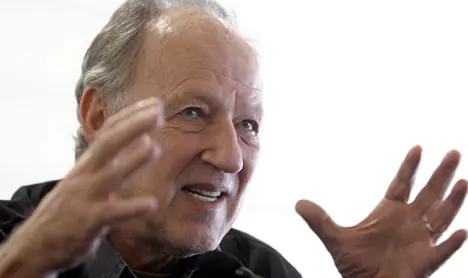
A rebel against the conservative filmmaking of the fifties, Herzog was part of the New German Cinema movement, and first gained widespread acclaim for his epic film “Fitzcarraldo” (1982).
Whether consciously or not, the director has constructed a myth around himself thanks to a raft of unusual cinematographic endeavours. Among many tales originating from his sets, the most legendary occurred while shooting “Fitzcarraldo,” when fights between him and the notoriously temperamental star Klaus Kinski became so unbearable that one of the indigenous men working as an extra offered to kill the actor.
Now with more than 50 films to his name, from popular features to documentaries, Herzog spoke with The Local ahead of recognising a new generation of talented filmmakers at the Berlinale awards next week.
You have a reputation of being a lone wolf, yet you are the jury president of the 60th Berlinale. How did that happen?
The lone wolf is a bit of stylization by the media. I had to be kind of persuaded to do it. I thought it was right to return to this festival with a real duty, as a working member of the festival. I was told that last year the films were extremely good. A young woman from Peru (Claudia Llosa’s “The Milk of Sorrow”) won the Golden Bear. I was in Peru not long ago and it has translated into a certain pride for the entire nation. In this case, I believe it does make sense to give awards to films. However, the other side of the coin is that I’ve always said films do not really need awards. Awards are much more for the agricultural fair where the prize goes for the cow with the best milk.
Why did you decide to set up the Rogue Film School?
During the last 25 years there have been an increasing number of people who see me as a point of orientation. I felt I had to give an organized response. I have something I can pass on. Its not technical things that you can learn at a local film school, its a different spirit - a rogue, guerilla style spirit.
Why are people so attracted to your movies?
I have managed against all odds to always make films I really wanted to make. And all this happened outside of the established film industry. Yet my films are all hidden mainstream movies. For example, my film “Aguirre: The Wrath of God,” which was made forty years ago, has become a mainstream movie. I am not an eccentric, I occupy the centre and all the rest is bizarre. I’m clinically sane, so to speak.
You have repeatedly said that your work seeks an ‘ecstatic truth.’ Could you define this?
I have always had a conflict with the so-called cinéma verité. We have to look beyond realism. We have to dig into a deeper stratum of truth, which is somehow deeply inherent in cinema but very hard to ever find. I’m looking for moments that are all of a sudden illuminating.
Do you seek for this kind of truth when you make documentaries?
I think that through imagination, stylization, invention we become much more truthful. I have done unusual things to do so. For example, in my film “Lessons of Darkness” I show Kuwait when the Iraqi army set the entire country on fire. It looked not just like a political crime, but a crime against creation itself. In the entire film there is not one single moment where you can recognize our planet. I declared this to be a science fiction movie, which brought much controversy. In Berlin, people howled at me in disgust and spat at me, but I wouldn’t like to miss such beautiful moments of controversy.
You often portray the struggle between man and nature. What attracts you to this relationship?
It’s not always a struggle. In a way it’s a distant echo of how I grew up in the mountains without the presence of technical civilization. I did not see movies until I was 11. I made my first phone call when I was 17. And I still do not have a phone. I function better in the Amazonian jungle, in Antarctica or the Sahara desert. I could work in a studio but I would never really feel at home.
What do you cherish most about your relationship with the late Klaus Kinski?
It’s a difficult question because it was such a complex relationship. But I would say discipline. His discipline combined with my discipline. Otherwise, it was just the struggle to domesticate the wild beast, which was a certain joy. It also created good results.
You said recently that your book “The Conquest of the Useless,” a journal of the two years you spent making “Fitzcarraldo” would survive your films. Why?
In my opinion there is more substance in my prose than in all my movies together. It is a more direct way to express oneself. In cinema you always have other aspects in between like finance, organization, actors or technical apparatus.
Does it matter if people are still reading it in 100 years?
I couldn’t care less about posterity because I won’t be around anyway. I could say it more drastically but I won’t. Maybe after a few beers in a bar I would tell you what I mean.
This interview was conducted with a group of journalists.
Comments