
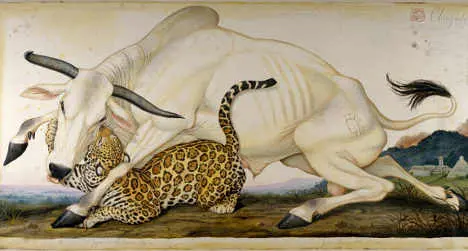
At first glance, his large-scale watercolours depicting muscular panthers, white wolves, cheeky birds and woolly buffaloes are similar to colonial-era natural history illustrations in the style of John James Audubon. But another look reveals arresting, disturbing allegories that recast the familiar man-versus-nature conflict in a way that has been aptly described as “Audubon on Viagra.”
The monkey eating fruit from a banquet table turns out to be leering aggressively at the beholder, and the snowy white bull is mounting the leopard – which is clenching the bull’s jugular between its jaws.
“I’m using a visual language from the 15th to 19th centuries that is pre-photographic and coincides with humans' first contact with many animals,” he told The Local on Thursday. “The difference is those were of a bird, and mine are about the bird. If it was literature you might call it revisionist.”
Click here for a gallery of Ford’s exhibition here.
In recent years Ford, who was born in New York in 1960, has enjoyed increasing success. In 2007 German art book publisher Taschen – whose books have come to serve as a seal of approval for artistic street cred – released a pricey limited edition book of Ford’s work "Pancha Tantra," followed by a more modest, but no-less stunning edition for the masses in 2009.
Two days before the opening of “Bestiarium” on Saturday, Ford appeared at Taschen’s store in the German capital to sign books for his admirers. Instead of inscriptions, Ford exuberantly drew tigers and Thylacines (an extinct carnivorous marsupial killed off in Tasmania by 1930) before giving his autograph.
He told The Local that he and his family have often had pets, from snakes, to guinea pigs to horses, adding that he has an “intrinsic understanding” of animals. At a young age Ford became fascinated with exhibits at the Museum of Natural History in New York, and later went on to study the work of American naturalist and painter Audubon.
Describing the 25 works created over the last decade that will appear at Berlin’s Hamburger Bahnhof contemporary art museum, a show he said is a “big deal” for him, Ford said they explore how animals live in the human mind through such things as folklore, superstition, and cultural history.
“There is so much science and popular interest regarding animals – like the Animal Planet shows and field research,” he said. “But that’s of no interest to me. I don’t care how gorillas behave in nature, but how people could come up with something like King Kong – how they could develop that kind of fear and terror, and we could come to accept him as an icon of nature.”
One of the paintings in the exhibit entitled, “An Encounter with Du Chaillu,” depicts a gorilla holding a rifle to its mouth as it stands before the lifeless feet of a man. Ford said that the 2009 painting references a 19th-century woodcutting of Western culture’s first experience with gorillas during an African expedition by French-American anthropologist Paul Belloni du Chaillu.
“They shot it, naturally,” Ford said.
But with the painting Ford inverts the act, showing the gorilla just moments after he has shot the man, and then, mimicking human remorse, decides to turn the gun on himself.
“It’s murder-suicide. In this moment he realises he’s fucked,” Ford said. “I’m asking the question about how our historical relationship with animals came about.”
The Massachusetts-based artist’s disposition is decidedly sunnier than his often brooding images, and though he joked that there’s probably “all kinds of sick reasons” for what drives his work, he acknowledged a joy in creating pieces that others appreciate.
“People just love old natural history art,” Ford told The Local. “An old friend of mine called it ‘slutty’ – it’s so irresistible. I’m not embarrassed about that. I’m a maximalist. The sexier the better.”
Walton Ford - Bestiarium
January 23 to May 24
Nationalgalerie im Hamburger Bahnhof - Museum für Gegenwart - Berlin
Invalidenstraße 50 – 51
Comments