
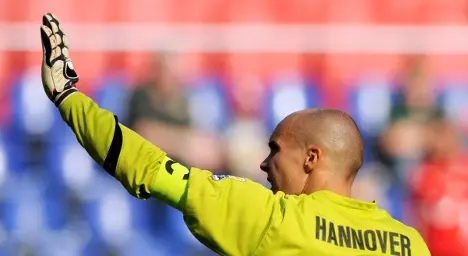
A week-and-a-half before Robert Enke stepped in front of a train on Tuesday, his father Dirk Enke, a qualified psychotherapist, went to Hannover to confront his 32-year-old son about his illness.
“For me it’s about understanding why there was such a wall, such closedness,” Dirk Enke told news magazine Der Spiegel. “Robert had very carefully made others believe everything was fine.
“I frequently offered to him: ‘Come on, let’s talk as father and son.’ I didn’t want to talk to him as a professional. Maybe he thought: ‘The old guy knows his stuff and is getting a sense of the fear I have.’ Robert had a feeling: ‘There’s something not right with my life.’”
For several weeks, Dirk Enke had urged his son to be treated as a hospital in-patient, he said.
“He was always so close to taking the step of having himself admitted (to hospital) and then he always said: ‘If I’m treated in a psychiatric clinic, that’s it for my football. And that’s the one thing I can do, and I want to do and love doing.”
Fear had triggered his son’s depression, Dirk Enke said.
“I’m of the opinion that the illness doesn’t originate inside, rather it arises out of the life circumstances,” he said.
This fear had already developed while Robert was young, his father said, not just in 2003, when Spanish side FC Barcelona, then Turkish team Fenerbahçe, dropped him from their squads, leaving him temporarily jobless.
As an early talent, he was placed in higher age groups, causing him to put pressure on himself.
“That was always causing crises, because he was scared he couldn’t keep up with the older players,” Dirk Enke said. “He put nothing past himself. He was trapped by his own expectations. At critical moments, Robert was scared that a ball would shoot into his goal. He had attacks, didn’t want to train, couldn’t imagine standing in goal.
"He was so full of doubt, he once asked me: 'Dad, would you think I was bad if I dropped out of football?’ I said: ‘For God’s sake, it’s not the most important thing.’”
Comments