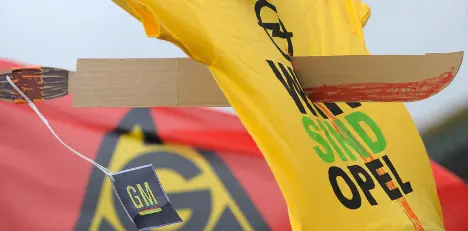
In 1958, East Germany’s communist leader Walter Ulbricht unveiled the “Ten Commandments of Socialist Morality and Ethics.” Referencing the biblical originals, the precepts were supposed to ease East Germans into atheism. The first of the new communist commandments ordered: “You shall support the international solidarity of workers as well as the steadfast bond between all socialist countries.”
But after US carmaker General Motors reneged on its agreement to sell its German unit Opel, it’s become apparent that Germany’s leftists would rather follow an 11th commandment: “Proletariat of the world, we don’t give a damn about you. We will never again sing ‘The Internationale,’ the song of the socialist workers movement. And we merrily spit on solidarity with workers beyond our borders.”
That’s partly a function of how unanimous the outrage in Germany has been following General Motors’ surprising decision not to sell Opel to the Canadian auto parts firm Magna.
Economy Minister Rainer Brüderle from Germany’s pro-business Free Democrats immediately cried foul: “Treating employees like this eight weeks before Christmas is absolutely inacceptable.” And the conservative Christian Democratic state premier of North Rhine-Westphalia, Jürgen Rüttgers, was equally outraged: “The behaviour of General Motors shows the ugly face of turbo capitalism.” Both sound no different than the railing of German worker councils, Social Democrats and members of the socialist party The Left. The monotone nationalist struggle to keep jobs in Germany has made the right and left thick as thieves.
The fact that Opel’s thousands of autoworkers in Britain, Spain, Belgium and Poland would probably suffer the most was ignored – and therefore approved – during the German love affair with the Magna consortium. Why should Klaus in Rüsselsheim care about jobs at Vauxhall? Nationalist self-interest always resurfaces during economic crises and in Germany it has been gaining steam with the help of the country’s trade unions. Marx, Engels and Rosa Luxemburg must be turning in their graves.
Of course, it’s not like this is anything new. It’s just that the Opel debate has sparked a general “Germany-first” trend. Just a year ago, in early November 2008, Deutsche Post – still about one-third owned by the German state – axed some 15,000 jobs in the United States. The company did a miserable job managing its DHL subsidiary, which won tax cuts and subsidies of $422 million from American taxpayers in 2004. The small town of Wilmington in Ohio was especially hard hit. The unemployment rate there was already alarming high and almost every family relied on DHL to put food on the table.
At the time, one of those standing at the edge of the abyss asked in despair: “Doesn’t your chancellor worry about the effect on German-American relations if there’s the impression that Deutsche Post is destroying the lives of lots of people in the heart of America?” But the chancellor cared as much as the rest of Germany. A German company firing Americans? What’s the problem? It only becomes an issue when it goes the other way.
So here’s an idea – since there is no longer any international solidarity, maybe there should at least be international equality. If General Motors lays off 10,000 workers soon, maybe they should get the same “generous” severance package that the former DHL workers in Wilmington received from Deutsche Post. That would not only be cheap (for GM) but also just from a transatlantic perspective.
This commentary was published with the kind permission of Berlin newspaper Der Tagesspiegel, where it originally appeared in German. Translation by The Local.
Comments