
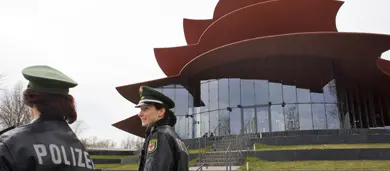
“It all went well,” police spokesman Rudi Sonntag said. There had been no specific threats but there was a moderate police presence inside and outside the venue “as a preventative measure” after complaints from some Muslim groups, the police spokesman said. Iran’s late revolutionary leader Ayatollah Ruhollah Khomeini issued a fatwa - or religious decree - in 1989 calling on Muslims to kill Rushdie for what the leader said were insults to Islam in his book. Officially the fatwa still stands.
There had been fears that Sunday’s play might become another flashpoint in tensions between Europe and the Muslim world. There have been protests in a number of Islamic countries after Danish newspapers last month reprinted a drawing of the Prophet Mohammed that offended many Muslims. Police had uncovered a plot to murder the cartoon’s author.
Dutch far-right MP Geert Wilders provoked further anger this week by posting on the Internet his film “Fitna” attacking Islamic ideology. Such fears appeared unfounded over Sunday’s play however. Some members of the 400-strong audience at the theatre in Postdam near Berlin even confided to reporters that at three and a half hours long, the play had been “boring.”
Rushdie, an Indian-born Muslim educated in Britain, was forced into hiding for nearly a decade. He was knighted by Britain’s Queen Elizabeth II in 2007, a move that sparked a new wave of protest across the Muslim world. The play was reworked for the stage by the manager of the Hans Otto Theatre, Uwe Eric Laufenberg, and dramatist Marcus Mislin - with Rushdie’s consent.
On Friday the president of the German Islamic Council, Ali Kizilkaya, told AFP that his organization had publicly complained. “We regret that the religious sentiments of Muslims are being treated in a provocative manner,” Kizilkaya had said.
The general secretary of the Central Council of Muslims in Germany, Aiman Mazyek, urged Muslims to remain calm and engage in a “critical and constructive dialogue” about the issues the play raises. But he also questioned whether the play might go too far.
“Freedom of expression and of art is important but offences against what is sacred in a religion is not something we value,” he told RBB public radio. In 2006, Berlin’s German Opera House hastily pulled a staging of Mozart’s “Idomeneo” featuring the severed head of the Prophet Mohammed over fears of protests by Muslims.
After a heated debate about self-censorship, the opera finally went ahead under tight security.
Comments